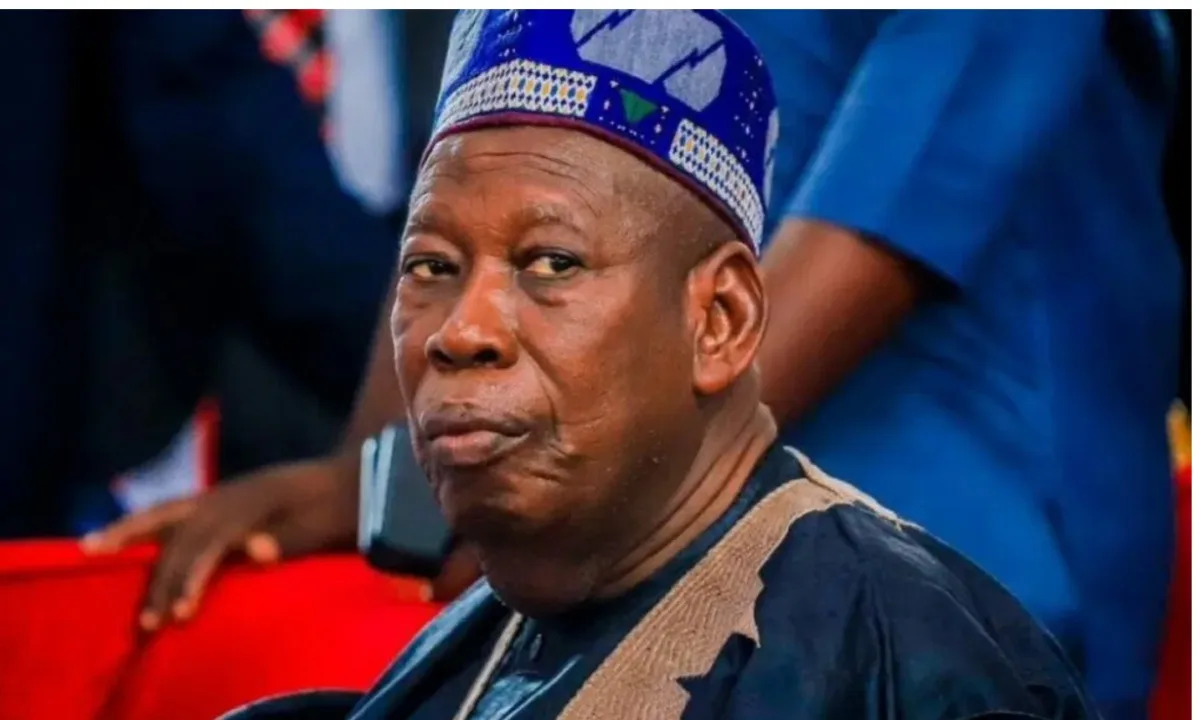
Abdullahi Umar Ganduje has thrown down the gauntlet. The former APC national chairman declared that neither Peter Obi nor Atiku Abubakar can muster enough northern support to unseat President Bola Tinubu in the 2027 presidential election. His statement lands at a time when opposition parties are scrambling to form coalitions and recalibrate strategies. The North remains the decisive battleground in Nigerian presidential politics. Ganduje’s assertion strips away the veneer of optimism that opposition figures have been projecting.
Ganduje’s argument hinges on structural deficiencies. He claims that both Obi and Atiku lack the grassroots machinery required to penetrate the North’s political landscape. The former Kano governor did not mince words. He told a public gathering in Kano that the North’s electoral weight makes it the kingmaker in every presidential contest. Without its backing, any candidate stands little chance of victory. This is not mere rhetoric. Historical voting patterns show that the North has consistently delivered block votes that tilt national elections. In 2015, Muhammadu Buhari’s northern support was instrumental in his victory. In 2023, Tinubu’s narrow win was secured through a combination of northern and southwestern votes.
The opposition’s coalition talks have been ongoing for months. Yet Ganduje remains unconvinced. He argues that realignments and memoranda of understanding between parties like the ADC and NDC have not translated into tangible grassroots structures. The former APC chairman’s skepticism is rooted in the reality of Nigerian politics. Winning elections requires more than high-profile endorsements. It demands local mobilisation, ward-level organisation, and the ability to counter the ruling party’s incumbency advantage. The North’s political terrain is complex. It is not monolithic. It is divided along ethnic, religious, and regional lines. Navigating these divisions requires deep-rooted alliances that neither Obi nor Atiku currently possess.
Ganduje’s critique extends beyond the opposition. He has called for stricter registration standards for political parties. His proposal targets the Independent National Electoral Commission. He wants INEC to recognise only parties with functional structures, clear ideologies, and nationwide presence. This is not a new demand. It echoes longstanding criticisms of Nigeria’s political party system. Over 18 registered parties exist, yet only a handful have the capacity to contest elections meaningfully. The rest are often vehicles for elite bargaining or spoiler candidates. Ganduje’s call for reform is a veiled attempt to consolidate the political space. It would make it harder for new or fringe parties to challenge the dominance of established ones like the APC and PDP.
The opposition’s response to Ganduje’s claims has been muted. Atiku Abubakar’s camp has not issued a direct rebuttal. Peter Obi’s team has remained silent. Their silence speaks volumes. It suggests a recognition of the challenges Ganduje has highlighted. The North’s political dynamics are not in their favour. Atiku, a northerner, was expected to have a natural advantage. Yet his repeated electoral failures in the region have exposed the limits of his influence. Obi, a southerner, faces an even steeper climb. His support base is concentrated in the Southeast and among urban youth. These demographics, while vocal, do not translate into the kind of block votes needed to win a national election.
Ganduje’s intervention reveals deeper institutional tensions. The APC is not a unified front. Internal divisions have surfaced in recent months. Ganduje’s public statements can be read as an attempt to rally the party’s northern base. By dismissing the opposition’s chances, he is reinforcing the narrative that the APC remains the only viable option. This is a strategic move. It aims to preempt defections and shore up support ahead of the 2027 polls. The APC’s incumbency advantage is significant. It controls federal resources, state apparatuses, and a vast patronage network. These tools will be deployed to secure re-election. Ganduje’s comments are a reminder that the opposition’s path to victory is narrow and fraught with obstacles.
The call for Atiku to drop his 2027 ambition adds another layer to the unfolding drama. Osita Okechukwu, a foundation member of the APC, has urged Atiku to step aside. His argument is rooted in the principle of zoning. He contends that the South should be allowed to complete its eight-year tenure. This is a contentious issue. Zoning has been a cornerstone of Nigeria’s political stability. It ensures rotational power-sharing between the North and South. Atiku’s decision to contest again, despite being a northerner, has been criticised as a breach of this convention. Okechukwu’s appeal is not just about fairness. It is a calculated move to weaken the opposition. By pressuring Atiku to withdraw, the APC hopes to fracture the opposition’s unity. It is a divide-and-rule tactic that has been used effectively in past elections.
Atiku’s response to these pressures will be critical. He has previously defended zoning. In 2011, he criticised then-President Goodluck Jonathan for seeking re-election, arguing that it violated the PDP’s zoning arrangement. His current stance is seen as hypocritical by some. Yet Atiku remains a formidable political operator. His experience and resources make him a serious contender. The question is whether he can overcome the structural and regional barriers that Ganduje has highlighted. The North’s political elite are not monolithic. There are factions within the APC and PDP that could be swayed. Atiku’s challenge is to exploit these divisions and build a coalition that can challenge Tinubu’s dominance.
The 2027 election is shaping up to be a referendum on Nigeria’s political future. The opposition’s ability to mount a credible challenge will depend on its capacity to address the structural weaknesses Ganduje has identified. It will also hinge on its ability to navigate the complex dynamics of northern politics. For now, the APC appears to hold the upper hand. Ganduje’s confidence is not misplaced. The North’s electoral weight is a reality that cannot be ignored. The opposition’s path to victory is narrow. It requires more than rhetoric. It demands grassroots mobilisation, strategic alliances, and a clear vision for Nigeria’s future. Without these, the 2027 election may well be a repeat of past contests, where the North’s block votes decide the outcome.