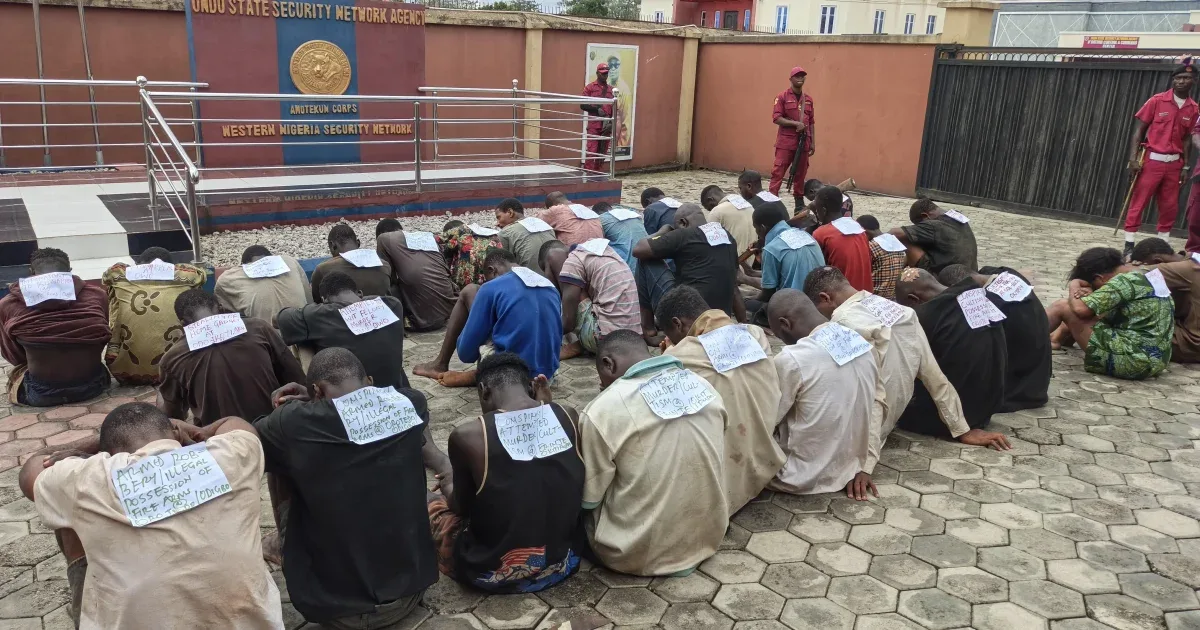

Forty-four teachers and pupils abducted from Ahoro Esiele community in Oyo State walked free on Friday after 56 days in captivity. The rescue operation ended a nightmare that began on May 15 when armed gunmen stormed the school. But the details emerging from the security agencies reveal a system still struggling to protect its citizens.
The Nigerian Army confirmed the rescue was the result of a month-long intelligence-led operation. Special units from the Office of the National Security Adviser, Defence Headquarters, and multiple security agencies participated. The operation targeted hideouts in the Old Oyo National Park and other locations across Nigeria. Lt.-Col. Danjuma Jonah Danjuma, spokesperson for the 2nd Division, said the coordinated effort led to multiple arrests in Oyo and other states. The pressure forced the kidnappers to release the victims unconditionally. Yet the operation also exposed critical weaknesses in Nigeria’s security architecture.
The rescue required a joint task force that included the Army, Navy, Air Force, Police, DSS, NSCDC, Amotekun, and local vigilantes. This level of coordination is rare. Security agencies often operate in silos, with poor information sharing. The success in Oyo was an exception, not the rule. The Army’s statement did not disclose how much ransom was paid or whether any kidnappers were killed. It only mentioned casualties among security forces. This opacity raises questions about the true cost of the operation and whether the government is learning from each incident.
The Oyo State wing of the Nigeria Union of Teachers hailed the rescue as a victory for humanity. NUT Chairman Hassan Ajibola Fatai and Secretary Olukayode Salami said the safe return lifted a burden from the education sector. They commended the federal and state governments for deploying resources to secure the release. But their statement also revealed a deeper crisis. Teachers across Oyo remained united and steadfast while praying for their colleagues. This unity was born out of fear. The abduction was not an isolated incident. It was the latest in a wave of attacks on schools in Nigeria’s northwest and north-central regions.
The Christian Association of Nigeria, Oyo State Chapter, described the rescue as an act of God’s faithfulness. CAN Chairman Rev. Elisha Ogundiya and Secretary Very Rev. Samuel Owolabi thanked the security agencies for their bravery. They also called for lasting peace and security in Oyo. Their statement, however, did not address the systemic failures that allowed the abduction to happen. Schools in rural areas remain vulnerable. Many lack perimeter fencing, security personnel, or early warning systems. The government’s response is reactive, not preventive. Each rescue operation is treated as a separate crisis, not part of a pattern.
The Oyo Renaissance Crusade, a local advocacy group, praised Governor Seyi Makinde for his leadership. They described his handling of the incident as empathetic and strategic. The group also used the moment to endorse the governorship candidate of the All Progressives Movement, Bimbo Adekambi. This political opportunism is not new. Security crises are often exploited for electoral gain. The ORC’s statement ignored the fact that Makinde’s administration has not implemented a comprehensive school security policy. The state still relies on ad-hoc measures, such as deploying Amotekun operatives after an attack.
The rescue operation’s success was not just about firepower. It was about intelligence. The Army’s statement highlighted the role of the National Counter Terrorism Centre and the National Intelligence Agency. These agencies provided the actionable intelligence that led to the arrests. But intelligence alone is not enough. Nigeria’s security agencies are underfunded and understaffed. The Police, for example, have a ratio of one officer to 600 citizens, far below the UN-recommended ratio of one to 400. The Army is stretched thin by multiple conflicts, from Boko Haram in the northeast to banditry in the northwest. The rescue in Oyo was a tactical victory, but it does not address the strategic failures.
The families of the rescued victims are now focused on recovery. The Army said the victims are receiving medical attention at an undisclosed hospital. But the psychological scars will linger. Many of the pupils and teachers were held in harsh conditions, with little food or water. Some may never return to the classroom. The government has not announced any plans for trauma counselling or financial support for the victims. This neglect is a recurring theme. After the Chibok girls were rescued, many struggled to reintegrate into society. The government’s response was slow and inadequate. The same pattern is repeating in Oyo.
The rescue of the Oyo abductees is a reminder of Nigeria’s security crisis. It is not just about kidnappings. It is about a state that is failing to protect its most vulnerable citizens. The government’s response is reactive, not proactive. Security agencies are overstretched and under-resourced. Schools in rural areas are soft targets. The rescue operation was a success, but it should not be celebrated as a solution. It is a temporary fix in a broken system. Until Nigeria addresses the root causes of insecurity—poverty, unemployment, weak institutions—the cycle of abductions will continue.