
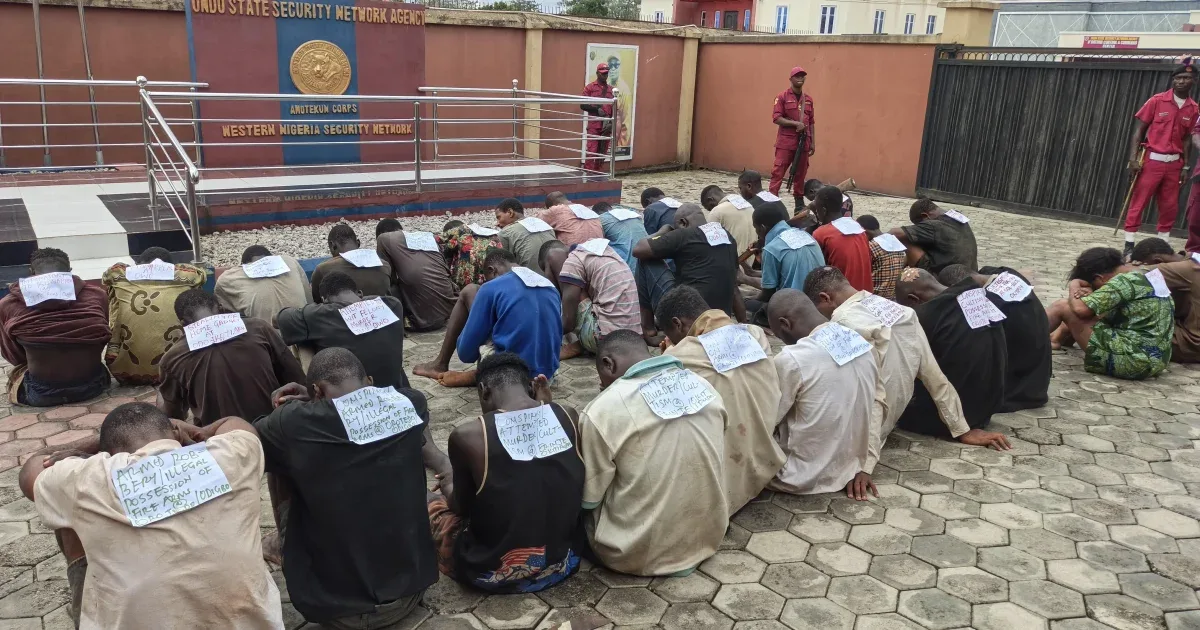
The Ondo State Security Network Agency, Amotekun Corps, has paraded 46 suspects arrested across the state’s 18 local government areas. Among them are a couple accused of burgling the residence of former Ondo State House of Assembly Speaker Jumoke Akindele in Okitipupa. The arrests follow a series of intelligence-led operations targeting kidnapping, armed robbery, and other criminal activities.
Commander Adetunji Adeleye disclosed that the couple, Samson Osowe (28) and his wife Ayo Oguneso (22), were caught with seven stolen mobile phones and other valuables. The phones, recovered during a foiled attempt to smuggle them to Lagos for sale, were displayed alongside the suspects. Adeleye confirmed that all stolen items from Akindele’s residence had been retrieved. The transporter hired to move the goods was also arrested, along with an accomplice still under investigation.
The remaining 44 suspects face charges ranging from kidnapping to illegal possession of firearms. Thirteen were arrested for kidnapping in Owo’s Government Reserve Area, while two were detained for violating the state’s anti-open grazing law. Others were linked to cultism, theft, and breach of peace. Adeleye emphasized that the arrests were part of a Sallah patrol operation, with all suspects set to face court proceedings immediately.
This crackdown exposes a troubling pattern of organized crime in Ondo State. The recovery of stolen goods from a high-profile political figure’s home underscores the audacity of criminal networks. More alarming is the involvement of a transporter in smuggling stolen items across state lines, revealing a possible syndicate operating beyond local boundaries. The arrests also highlight the vulnerability of rural communities, where kidnapping and armed robbery remain rampant despite security efforts.
The Amotekun Corps’ success in dismantling these networks raises critical questions about Nigeria’s centralized policing model. While federal agencies struggle with jurisdictional limitations, state-level outfits like Amotekun demonstrate the effectiveness of localized intelligence and rapid response. The arrests of 500 suspects this year alone—many of whom have been convicted—prove that community-based security structures can fill gaps left by national agencies. Yet, without constitutional backing, Amotekun’s operations remain constrained by legal ambiguities.
Public reaction to the arrests has been mixed. Residents of Okitipupa and Owo have praised the swift recovery of stolen items, but concerns persist about the recurrence of such crimes. The involvement of a transporter in the burglary scheme suggests that criminal networks are adapting, using legitimate businesses as cover. Meanwhile, the anti-open grazing arrests reflect growing tensions between herders and farmers, a conflict that state governments have struggled to manage without federal support.
The Ondo State Government’s decision to release impounded motorcycles—provided owners present valid documents—signals a shift toward rehabilitation over punitive measures. However, this approach risks emboldening repeat offenders if not paired with stricter enforcement. The Amotekun Corps’ reliance on community tips for arrests further underscores the need for sustained public trust. Without it, informants may hesitate to come forward, allowing criminals to exploit gaps in intelligence sharing.
As the debate over state police intensifies, the Amotekun model offers a compelling case for decentralization. The corps’ ability to operate across local governments, combined with its focus on community engagement, has yielded tangible results. Yet, its limitations—such as the lack of prosecutorial powers—highlight the need for a hybrid security framework. Until Nigeria’s policing structure evolves, outfits like Amotekun will remain a stopgap, not a solution.