
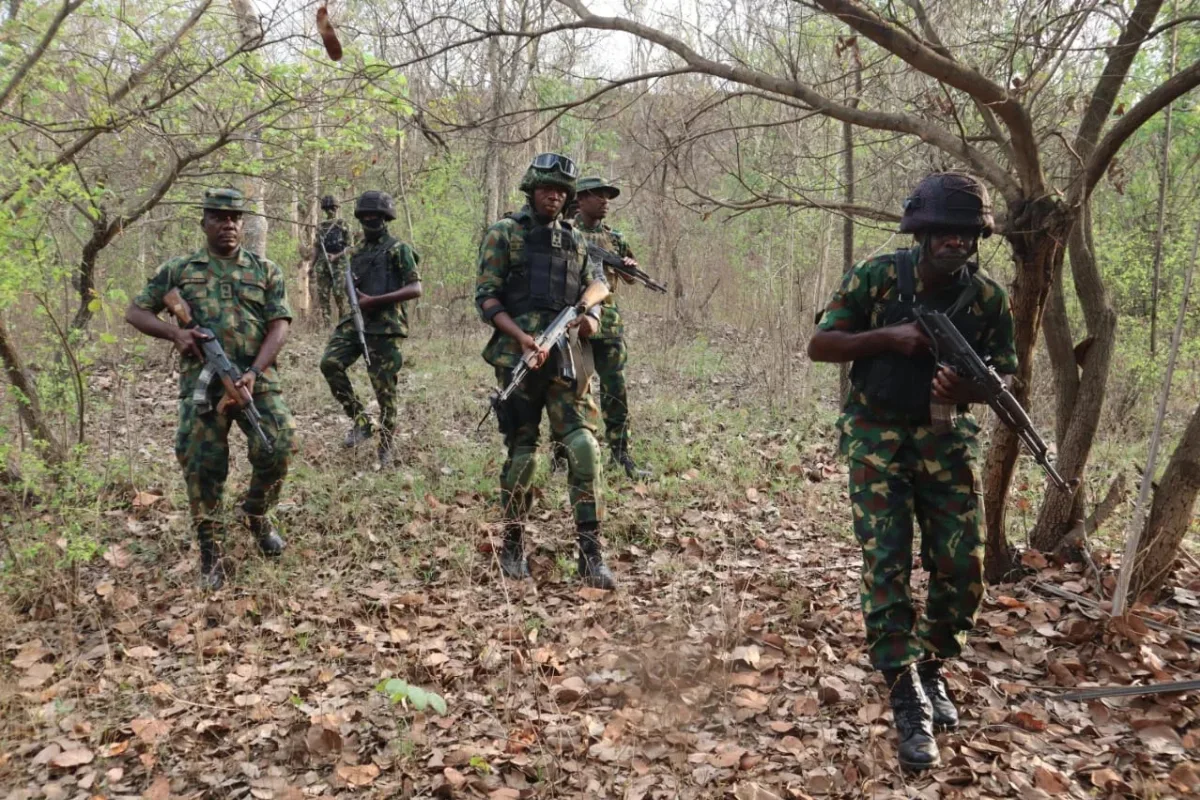
Nigerian troops under Operation FANSAN YAMMA have launched a series of coordinated raids in Sokoto and Katsina states. The military confirmed the rescue of abducted civilians, recovery of rustled livestock, and seizure of weapons from armed groups. These operations mark a critical escalation in the fight against terrorism and banditry in the North-West region.
The first operation unfolded in Tureta Local Government Area of Sokoto State on June 21. Troops intercepted armed terrorists attempting to infiltrate Tureta town. Acting on credible intelligence, soldiers engaged the attackers in a firefight. The assailants abandoned their mission and fled. Aerial surveillance later tracked the fleeing suspects to Sulubawa Gidan Kare village. There, troops discovered the terrorists moving with abducted civilians and rustled cattle. A pursuit operation was immediately launched. Despite encountering an ambush, the soldiers overpowered the attackers. The military reported the rescue of abducted victims, recovery of stolen cattle, and seizure of two motorcycles used by the terrorists.
A separate raid was conducted in Matazu Local Government Area of Katsina State in the early hours of June 22. Troops targeted a suspected terrorist hideout. The surprise assault overwhelmed the occupants, leading to a gun battle. Two terrorists were neutralised. Several others escaped with gunshot wounds. A search of the hideout yielded significant recoveries. Troops seized one PKT assault rifle, one AK-47 rifle with ammunition, three motorcycles, communication devices, and rustled livestock. The military described these items as critical logistical support for terrorist operations in the region.
These operations reflect a broader military strategy to dismantle criminal networks in the North-West. The Nigerian Army has intensified efforts following repeated attacks in Sokoto and Katsina. Communities in Sabon Birni, Isa, and Goronyo have faced persistent violence. The military has also responded to warnings of renewed movements by fighters linked to notorious bandit leader Bello Turji. In Katsina, operations have been stepped up after the abduction and death of retired Major General Rabe Abubakar. The military launched Operation CLEAN SWEEP III to dismantle bandit enclaves in Matazu and surrounding areas.
The success of these raids exposes critical gaps in the security architecture of the North-West. Despite military pressure, armed groups continue to operate with relative impunity. The recovery of communication devices and motorcycles suggests these groups maintain sophisticated logistical networks. The military’s reliance on aerial surveillance and intelligence-led operations indicates a shift toward precision strikes. However, the persistence of ambushes and the escape of wounded terrorists reveal vulnerabilities in ground operations. These incidents highlight the need for enhanced coordination between air and ground units to prevent retreating attackers from regrouping.
Local communities remain caught in the crossfire of this conflict. The rescue of abducted civilians and recovery of rustled livestock provide temporary relief. Yet, the cycle of violence continues unabated. Residents in affected areas report increasing displacement and economic disruption. The military’s assurance of sustained operations offers little comfort to those living under constant threat. The failure to dismantle the financial networks funding these groups allows them to replenish weapons and recruit new members. Without addressing the root causes of banditry—such as poverty, unemployment, and weak governance—the military’s efforts risk becoming a perpetual game of whack-a-mole.
The military’s public statements emphasize professionalism and resolve. Lieutenant Colonel Aliyu Danja, the Media Information Officer of Operation FANSAN YAMMA, described the operations as a testament to troop determination. He reaffirmed the military’s commitment to restoring peace and security. Yet, the lack of independent verification of these claims raises questions about transparency. The military’s history of underreporting casualties and overstating successes has eroded public trust. Without third-party validation, the true impact of these operations remains uncertain. This opacity undermines efforts to build confidence among local populations and international observers.
The broader implications of these raids extend beyond immediate security concerns. The North-West’s instability has national ramifications. The region serves as a transit corridor for arms smuggling and human trafficking. The persistence of armed groups fuels cross-border criminal networks. The military’s operations in Sokoto and Katsina are part of a larger effort to secure Nigeria’s northern borders. However, the lack of a comprehensive strategy—encompassing economic development, community engagement, and regional cooperation—limits the effectiveness of these efforts. The federal government’s reliance on military solutions without addressing underlying socio-economic issues risks perpetuating the cycle of violence.
The military’s recent successes must be viewed within the context of Nigeria’s broader security challenges. The North-West is not the only region grappling with insurgency and banditry. The North-East faces the resurgence of Boko Haram and ISWAP. The South-East contends with separatist agitations and armed criminality. The military’s stretched resources and competing priorities raise questions about its ability to sustain operations across multiple fronts. The federal government’s failure to implement a cohesive national security strategy leaves the military overburdened and under-resourced. Without political will and structural reforms, the gains in Sokoto and Katsina may prove temporary.


