
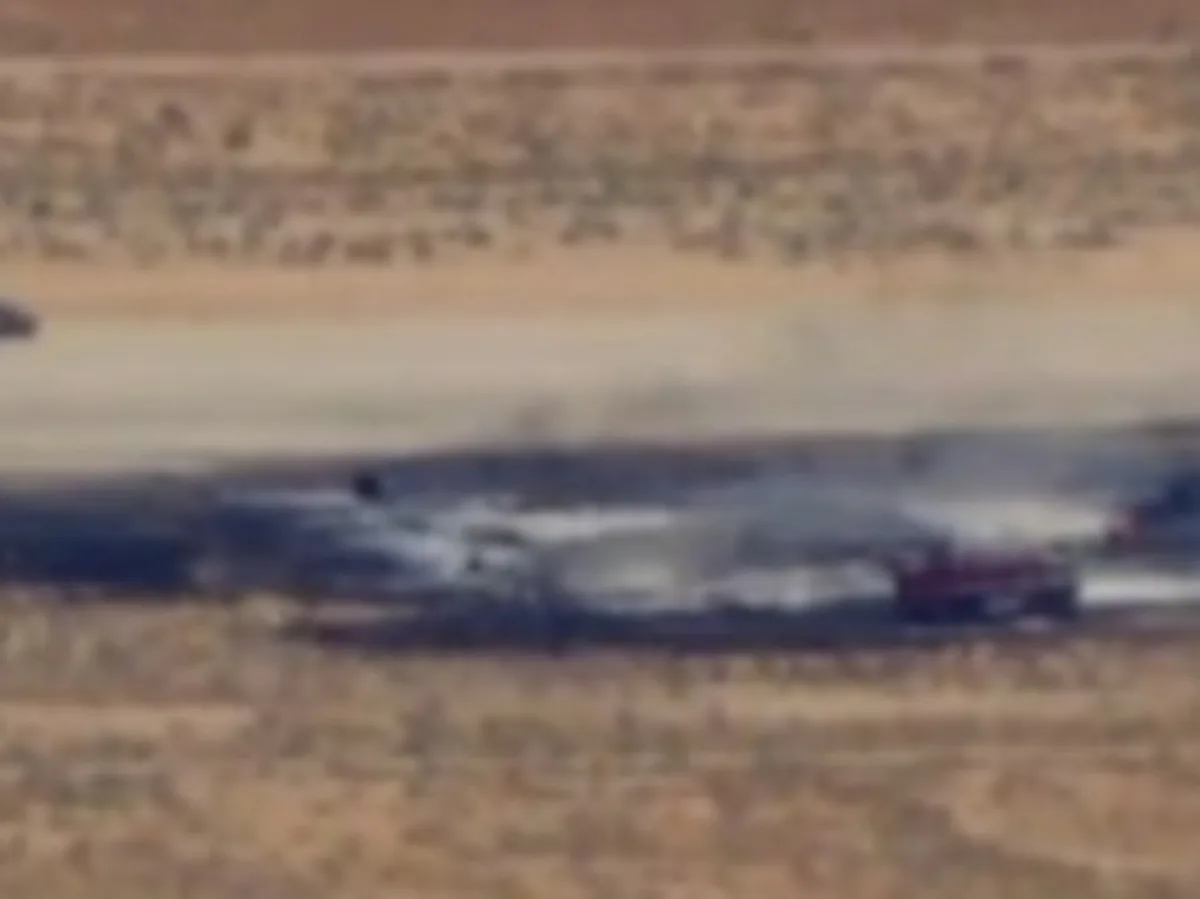
The United States Air Force confirmed that eight personnel aboard a B-52 Stratofortress bomber died when the aircraft crashed shortly after takeoff from Edwards Air Force Base in California. The incident occurred at 11:20 a.m. local time on Monday. Emergency crews responded immediately but found no survivors. The base issued a statement declaring the crash "not survivable."
Aerial footage revealed a vast scorched area where the bomber impacted the desert floor. Thick black smoke billowed into the sky as firefighters and rescue teams secured the site. The Air Force has not released the names of the crew members or disclosed whether the aircraft carried weapons. Edwards Air Force Base, located 100 miles north of Los Angeles, serves as the primary testing ground for new aircraft and weapons systems. The base temporarily closed its airfield and diverted all incoming flights to facilitate emergency operations.
The B-52 Stratofortress entered service in 1955 and remains a cornerstone of the US strategic bomber fleet. Designed to deliver both conventional and nuclear payloads, the aircraft has participated in every major US military conflict since Vietnam. The bomber typically carries a crew of five but can accommodate additional personnel for test missions. Aviation safety expert Jeff Guzzetti suggested the crash may have resulted from a flight control malfunction or engine failure, though investigators have not confirmed any cause.
The crash exposes systemic vulnerabilities in the Air Force’s aging bomber fleet. The B-52, originally built to counter Soviet threats during the Cold War, has undergone multiple upgrades but still relies on 70-year-old airframe designs. Maintenance records show the fleet has experienced repeated hydraulic and electrical failures in recent years. The Air Force has delayed the introduction of the B-21 Raider, the next-generation bomber, citing budget constraints and technical delays. This crash marks the second fatal B-52 accident in five years, raising questions about the sustainability of operating vintage aircraft.
Edwards Air Force Base holds a critical role in the Pentagon’s test and evaluation pipeline. The 412th Test Wing, stationed at Edwards, evaluates new aircraft, weapons, and software before operational deployment. The base’s remote location in the Mojave Desert provides secure airspace for high-risk test flights. However, the crash highlights the inherent dangers of experimental aviation. The Air Force has not disclosed whether the B-52 was testing new equipment or conducting a routine training mission. Previous accidents at Edwards have involved prototype aircraft, underscoring the risks of pushing technological boundaries.
The investigation will focus on three key areas: mechanical failure, human error, and environmental factors. Flight data recorders, if recovered, will provide critical insights into the final moments before impact. The Air Force has not ruled out the possibility of a catastrophic structural failure, given the aircraft’s age. Crew training records will also come under scrutiny, particularly if the mission involved experimental procedures. Weather conditions at the time of the crash were reportedly clear, eliminating turbulence or visibility issues as potential causes.
The crash reverberates beyond military circles, impacting US defense policy and industrial strategy. The Air Force has lobbied Congress for increased funding to accelerate the B-21 Raider program, arguing that the B-52 fleet is increasingly unreliable. Lawmakers have resisted, citing cost overruns and schedule delays. This accident may shift the political calculus, forcing a reevaluation of the trade-offs between maintaining legacy systems and investing in next-generation platforms. Defense contractors, including Boeing and Northrop Grumman, stand to benefit if the crash triggers a surge in modernization funding.
The human toll of the crash extends to the families of the eight crew members. The Air Force has not released their identities, but military protocol requires notification of next of kin before public disclosure. The incident serves as a stark reminder of the dangers faced by test pilots and support crews. Edwards Air Force Base has a memorial honoring aviators killed in the line of duty, and the names of the latest victims will likely be added to the monument. The base will hold a private ceremony for the families, while the broader military community mourns the loss of experienced personnel.