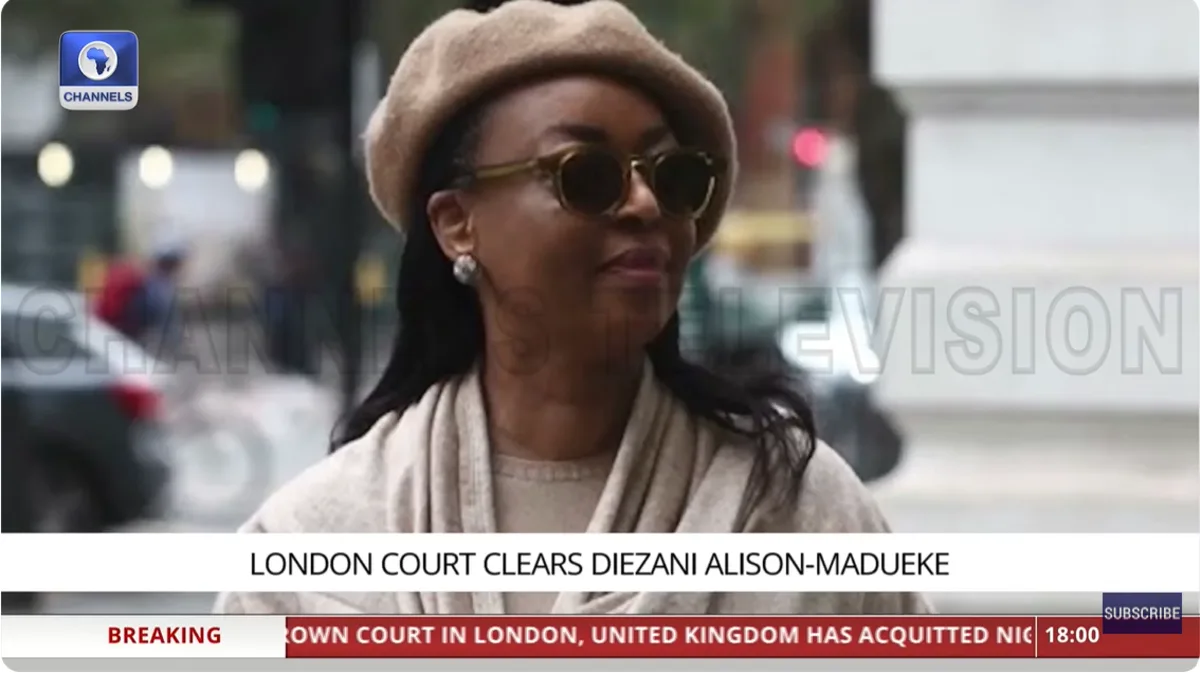
Diezani Alison-Madueke walked out of Southwark Crown Court a free woman. The jury cleared her of all bribery charges after a trial that lasted five months. The verdict did not just end a 13-year investigation. It revealed deep cracks in how Nigeria and the United Kingdom fight high-level corruption.
The former Nigerian oil minister faced five counts of accepting bribes and one count of conspiracy. Prosecutors claimed oil executives paid for her London homes, private jets, and luxury goods. They said she let these men bankroll her lifestyle while she controlled Nigeria’s oil contracts. The jury disagreed. They found no proof she awarded contracts in exchange for the benefits. They also accepted her claim that she reimbursed every expense.
The case hinged on missing evidence. Alison-Madueke told the court she kept receipts for every payment. She said Nigerian authorities seized these documents during a raid on her Abuja home in 2015. The National Crime Agency never saw the original records. It relied instead on copies provided by Nigeria’s Economic and Financial Crimes Commission. The defense argued the EFCC could not be trusted. It pointed out the same agency cleared one co-defendant while prosecuting another. The jury sided with the defense.
The acquittal leaves Nigeria’s oil sector exposed. Alison-Madueke served as petroleum minister from 2010 to 2015. She also became the first woman to lead OPEC. During her tenure, Nigeria lost billions of dollars to opaque contracts. The UK investigation tried to hold her accountable. It failed. The verdict sends a clear message. Nigeria’s elite can exploit legal loopholes across borders. The country’s anti-corruption agencies lack the tools to stop them.
The trial uncovered a systemic flaw in cross-border prosecutions. The National Crime Agency spent 13 years building the case. It never secured the cooperation of key witnesses. The oil executives accused of paying bribes never stood trial. Some live in Nigeria. Others moved to the United States. The UK could not extradite them. The prosecution relied on testimony from Olatimbo Ayinde, a co-defendant who claimed she acted as an informant. The jury acquitted her too. The case collapsed without direct evidence.
The verdict also exposed gender bias in Nigeria’s political system. Alison-Madueke testified that her rise to power made her a target. She was the first woman to lead the petroleum ministry. She broke barriers in a male-dominated industry. She said powerful men resented her authority. They spread corruption allegations to discredit her. The jury did not dismiss her claims. It acknowledged the hostility she faced. The trial became a rare public discussion of sexism in Nigerian politics.
The fallout extends beyond Nigeria. The United States had its own case against Alison-Madueke. In 2017, the Department of Justice accused her of laundering bribes through American banks. That case remains unresolved. The UK acquittal weakens the US position. It also raises questions about global anti-corruption efforts. Wealthy nations often prosecute foreign officials in their courts. The Alison-Madueke case shows how hard that is. Without local cooperation, evidence disappears. Witnesses refuse to testify. Cases drag on for years. Justice becomes impossible.
The National Crime Agency called the verdict disappointing. It said it respected the jury’s decision. Anti-corruption groups called it a setback. They warned that elites will see the acquittal as a green light. Nigeria’s government has not commented. The country still faces pressure to reform its oil sector. The Alison-Madueke trial proved one thing. Without stronger laws and better cooperation, corruption will continue. The verdict did not clear her name. It exposed a broken system.