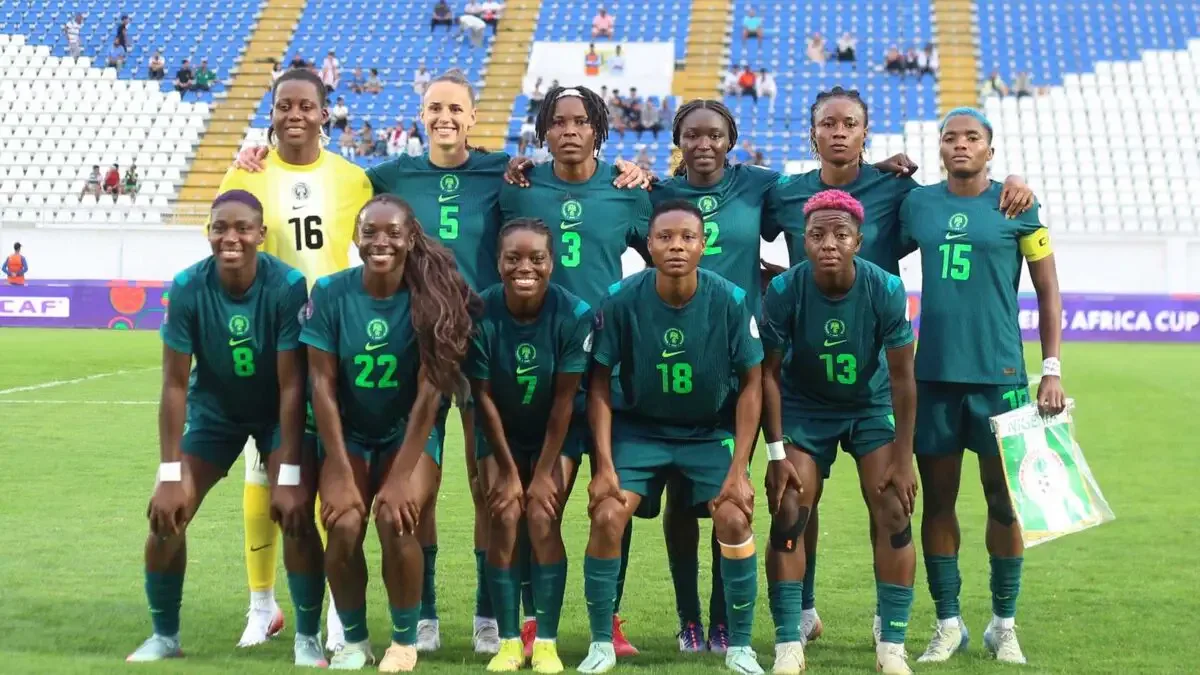
The Super Falcons’ 25-player roster for WAFCON 2026, unveiled by head coach Justin Madugu, carries the weight of a record-extending 11th continental title—and the unspoken pressure of a squad beginning to fracture along tactical lines. While the squad list reads like a who’s who of African women’s football, the omission of Ashleigh Plumptre, a defensive lynchpin in last year’s triumph, exposes deeper structural vulnerabilities that could derail Nigeria’s title defence before the tournament even kicks off.
Plumptre’s absence, officially attributed to injury, arrives at a critical juncture. The Al Ittihad centre-back was instrumental in Nigeria’s 3-2 victory over Morocco in the 2024 final, marshalling a backline that conceded just three goals across six matches. Her replacement, 21-year-old Sikiratu Isah, brings pace but lacks the same positional discipline in high-pressure scenarios. This shift forces Madugu into a tactical recalibration: abandoning the three-at-the-back system that delivered last year’s trophy in favour of a more fluid 4-3-3, a formation that demands greater midfield cohesion and full-back endurance—two areas where the Super Falcons have shown alarming inconsistency in recent friendlies.
The squad’s defensive frailties are further compounded by the inclusion of Rofiat Imuran, whose erratic form at London City Lionesses saw her rotated out of the starting XI for much of the 2025-26 season. Imuran’s selection over more reliable options like Peace Efih, who has thrived in Spain’s Liga F, suggests a boardroom interference that prioritises marquee names over tactical suitability. This decision mirrors the broader institutional dysfunction plaguing Nigerian football, where short-term optics often override long-term strategic planning—a pattern that cost the team dearly during the 2023 World Cup.
Midfield presents another selection dilemma. While the trio of Halimatu Ayinde, Deborah Abiodun, and Christy Ucheibe offers a blend of steel and creativity, their collective inability to control tempo against technically superior opponents has been exposed in recent losses to Brazil and Japan. The absence of a true deep-lying playmaker—someone capable of dictating play from the base of midfield—leaves the Super Falcons vulnerable to counter-attacks, particularly against Zambia, whose transition play has improved markedly under Bruce Mwape. Madugu’s reliance on Rasheedat Ajibade to drop deep and orchestrate attacks from the left wing, while innovative, risks leaving the forward line devoid of its most potent goal threat.
Upfront, the squad’s over-reliance on Asisat Oshoala’s clinical finishing masks a deeper creativity crisis. Oshoala, now 32 and playing in Saudi Arabia’s nascent women’s league, remains Nigeria’s most lethal finisher, but her mobility has declined. The lack of a natural successor is glaring: Gift Monday, despite her technical gifts, has struggled to replicate her club form at international level, while Esther Okoronkwo’s direct running often bypasses the midfield entirely, leading to disjointed build-up play. This over-dependence on Oshoala was starkly evident during Nigeria’s 2-1 friendly defeat to Sweden in June, where the team created just two clear chances—both falling to the Barcelona striker.
The tournament’s expanded format—16 teams for the first time—introduces a new layer of tactical complexity. Nigeria’s group-stage opponents, Egypt and Zambia, have both adopted possession-based systems that could exploit the Super Falcons’ defensive disorganisation. Egypt’s 4-2-3-1, built around the creative interplay of Sara Essam and Noha Tarek, will test Nigeria’s high defensive line, while Zambia’s 3-5-2, with Barbra Banda operating as a false nine, could stretch the already fragile back four. Madugu’s insistence on a high press, effective against minnows like Malawi, may backfire against these more sophisticated opponents, particularly in Morocco’s sweltering summer conditions.
Beyond the tactical concerns, the squad’s psychological resilience is under scrutiny. The Super Falcons’ dressing room fracture, simmering since the 2023 World Cup, has resurfaced in the lead-up to WAFCON. Reports from Nigeria’s pre-tournament camp in Abuja indicate a divide between the European-based players—led by Ajibade and Oshoala—and the locally based contingent, who feel marginalised in selection discussions. This tension was exacerbated when Madugu reportedly overruled his technical staff to include Folashade Ijamilusi, a forward with just two international caps, ahead of more experienced options like Chinonyerem Macleony. Such boardroom interference not only undermines the coaching staff but also risks creating a two-tier squad dynamic that could erupt under the pressure of knockout football.
The financial stakes of WAFCON 2026 add another layer of pressure. With the tournament doubling as a qualifier for the 2027 Women’s World Cup in Brazil, Nigeria’s failure to reach the semi-finals would trigger a crisis of confidence in the women’s game domestically. The Nigerian Football Federation (NFF) has already slashed funding for the NWFL by 40% in 2026, redirecting resources to the men’s team ahead of the 2026 World Cup. A poor showing in Morocco could accelerate this decline, leaving the next generation of Super Falcons prospects without a viable domestic pathway. The NFF’s decision to exclude the NWFL champions, Bayelsa Queens, from pre-tournament friendlies—despite their unbeaten 2025-26 season—further underscores the disconnect between the national team and the grassroots structures that should sustain it.
Madugu’s tactical masterclass in the 2024 final, where Nigeria’s second-half substitutions turned a 2-0 deficit into a 3-2 victory, papered over these cracks. But WAFCON 2026 will demand more than reactive adjustments. The Super Falcons’ opening match against Malawi, a team ranked 120th in the world, offers a false sense of security. The real tests—Zambia and Egypt—will expose whether this squad is built on tactical cohesion or merely the remnants of past glory. With Plumptre’s absence leaving a void no single player can fill, Nigeria’s title defence hinges on Madugu’s ability to transform a collection of individual talents into a functional unit. The clock is ticking.