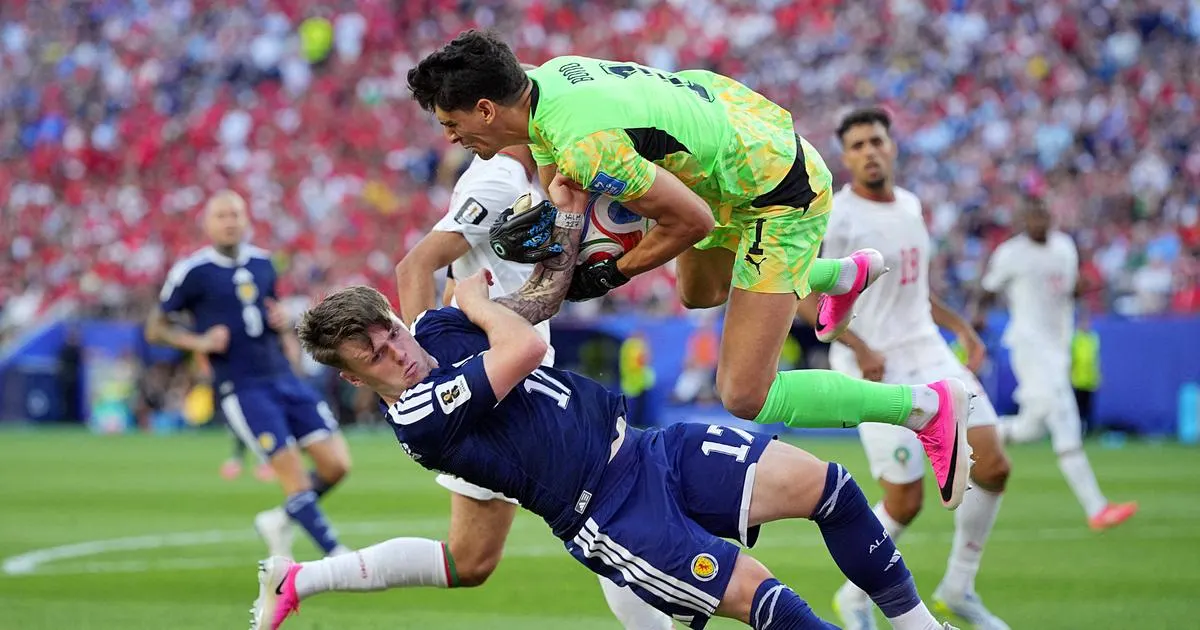
Ismael Saibari did not just score the fastest goal of the 2026 World Cup. He delivered a tactical masterclass that exposed Scotland’s defensive frailty and sent Morocco top of Group C with four points from two matches. The 22-year-old midfielder, already Bayern Munich-bound, struck after 70 seconds in Foxborough, latching onto Brahim Díaz’s weighted pass before firing past Angus Gunn. That single moment shifted the entire momentum of the game, leaving Scotland shell-shocked and Morocco in control of their own destiny ahead of their final group fixture against Haiti.
Saibari’s performance was not merely about pace or finishing. It revealed a deeper tactical intelligence that Morocco have weaponised under Walid Regragui. Against Scotland’s deep defensive block, Saibari operated as a false winger, drifting inside to exploit the half-spaces between centre-back and full-back. His movement dragged Grant Hanley out of position, creating the opening for the early goal. Later, he struck the crossbar from 25 yards, a reminder that his threat extends beyond poaching in the box. Scotland’s midfield trio of Ryan Christie, John McGinn, and Scott McTominay were repeatedly bypassed as Saibari dropped into pockets of space, turning transitions into counterattacks before Scotland could regroup.
The structural imbalance in Scotland’s setup became glaring after Saibari’s opener. Steve Clarke’s decision to deploy Kieran Tierney as a left-sided midfielder in a 4-5-1 formation backfired immediately. Tierney, a natural full-back, was caught between roles—too advanced to track Morocco’s wingers, yet too deep to press Saibari effectively. The enforced substitution of Tierney after 60 minutes, replaced by Ben Gannon-Doak, only underscored the selection dilemma Clarke faces. Without a natural left-footed creator, Scotland’s attacks lacked incision, resorting to hopeful crosses that Yassine Bounou dealt with comfortably.
Morocco’s defensive organisation, meanwhile, highlighted the gulf in tactical discipline. Regragui’s side defended in a 4-1-4-1 shape, with Azzedine Ounahi screening the back four and Bilal El Khannouss dropping into midfield to cover Scotland’s direct runners. The contrast was stark: while Scotland’s midfield collapsed under pressure, Morocco’s structure remained intact even when pinned back. Bounou’s post-match insistence that Morocco “controlled the game” was not mere bravado. The Atlas Lions limited Scotland to just two shots on target—both from McTominay in the final 10 minutes—despite enjoying only 48% possession.
The hidden subplot of Morocco’s victory lies in the squad’s generational shift. Saibari, El Khannouss, and Ounahi represent a new wave of Moroccan talent bred in Europe’s top academies. Their technical proficiency and tactical awareness have rendered Morocco less reliant on the physicality of players like Hakim Ziyech and Achraf Hakimi, who were peripheral in this match. Saibari’s two goals in the tournament—both match-winners—have already eclipsed Ziyech’s output, raising questions about the veteran winger’s future role. Regragui’s willingness to bench established stars in favour of younger, more dynamic options signals a deliberate break from the past, one that could define Morocco’s trajectory in this World Cup and beyond.
Scotland’s survival in the group now hinges on a mathematical equation. A draw against Brazil in their final match would suffice if Haiti fail to beat Morocco by a wide margin. Yet the underlying issues—midfield collapse, defensive disorganisation, and a lack of creativity—will not be fixed by mere hope. Clarke’s conservative approach, prioritising defensive solidity over attacking fluidity, has left Scotland vulnerable to teams that can exploit their rigidity. The absence of a true playmaker, compounded by McTominay’s late-game heroics being their only consistent threat, suggests a ceiling that has already been reached.
For Morocco, the victory masks a lingering frustration: their inability to convert dominance into a wider goal margin. Against both Brazil and Scotland, they have created enough chances to win by three or four goals but managed just one. The final ball, particularly from Díaz, has been the weak link. His hesitation in the 85th minute, when he opted to dribble instead of releasing Saibari in space, cost Morocco a second goal. Regragui’s post-match debrief will likely focus on this profligacy, as Haiti’s porous defence—conceding three to Brazil—offers an opportunity to rectify it. A high-scoring win would not only secure top spot in the group but also send a statement to potential knockout opponents.
The boardroom friction beneath Morocco’s success adds another layer of intrigue. Bayern Munich’s reported £60 million bid for Saibari, expected to be finalised after the tournament, has sparked internal debate. Sources close to the Moroccan FA suggest some officials favour delaying the transfer until January to avoid destabilising the squad mid-campaign. Others argue that Saibari’s form justifies an immediate move, with the funds earmarked for infrastructure projects. The tension between sporting ambition and financial pragmatism could spill into the dressing room if not managed carefully, particularly if Saibari’s focus wavers ahead of the Haiti match.
Morocco’s title credentials will be tested in the knockout stages, where their tactical flexibility and squad depth will face sterner challenges. Yet their victory over Scotland was not just about three points. It was a demonstration of how a team can evolve beyond its stars, embracing a new identity built on speed, intelligence, and ruthlessness. If Saibari continues to dictate games, and Regragui’s system remains adaptable, Morocco could emerge as the dark horses of this tournament—capable of outplaying any opponent, even if they don’t always outscore them.