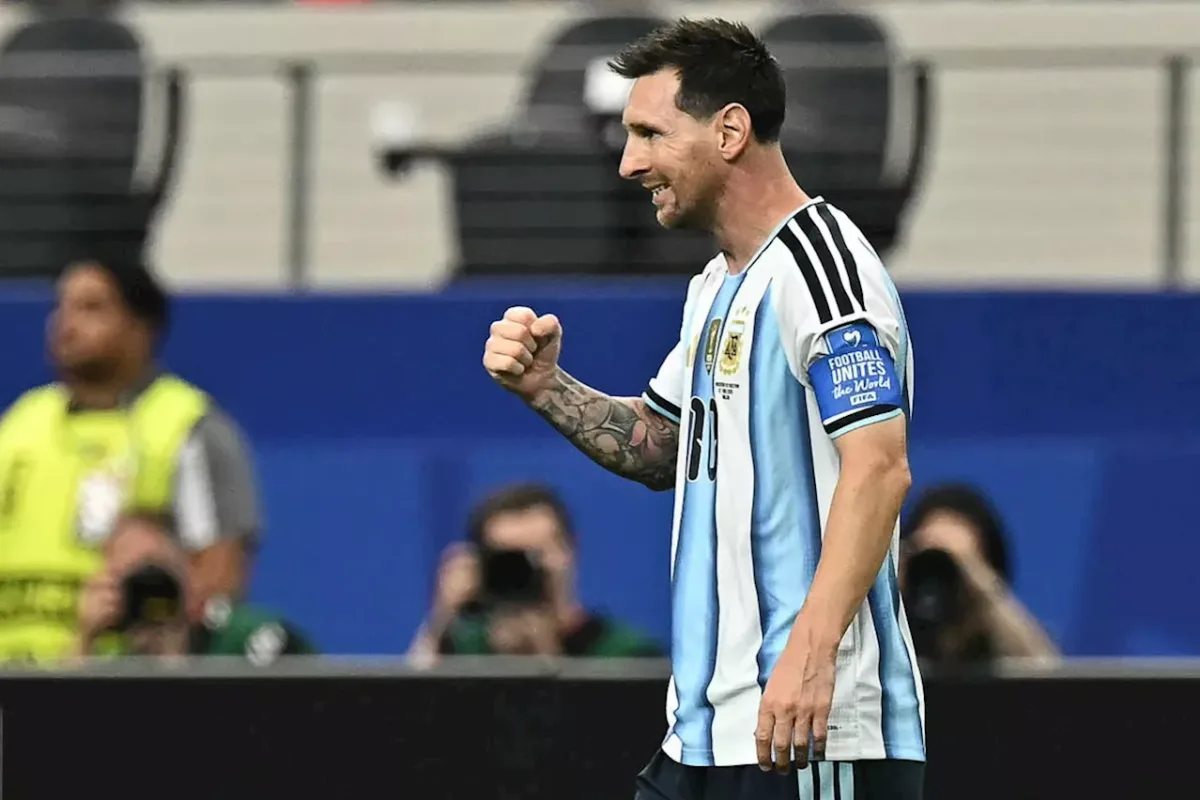
Lionel Messi’s seven goals lead the 2026 World Cup scoring charts, but Argentina’s 3-2 extra-time victory over Cape Verde exposed defensive frailties that could derail their title defence. The match in Miami Stadium saw Argentina concede twice in regulation time, forcing a nervy extra period where a 111th-minute own goal by Diney Borges sealed progression. Messi’s clinical finishing masked a midfield collapse that allowed Cape Verde’s Deroy Duarte and Sidny Lopes Cabral to exploit space behind Enzo Fernández and Alexis Mac Allister. The pattern mirrors Argentina’s group-stage struggles—conceding first in three of four matches—raising questions about Lionel Scaloni’s tactical rigidity.
Argentina’s defensive line, anchored by Cristian Romero and Lisandro Martínez, has been breached 11 times in five tournament matches, the highest among quarter-finalists. The issue stems from Scaloni’s insistence on a high defensive line, leaving Romero isolated against pacey forwards. Cape Verde’s equaliser in the 87th minute came from a rapid counterattack, with Yannick Semedo’s cross finding Lopes Cabral unmarked in the box. The same vulnerability surfaced in Argentina’s group-stage draw with Spain, where Rodri’s through ball split the centre-backs. Scaloni’s refusal to adjust the system—despite Martínez’s repeated warnings about overcommitment—has become a glaring weakness as the knockout stage intensifies.
The midfield’s structural imbalance compounds the problem. Fernández and Mac Allister are tasked with both defensive cover and creative output, a dual role that has led to fatigue and positional lapses. Against Cape Verde, Fernández completed just 78% of his passes in the final third, his lowest accuracy in the tournament. Mac Allister’s defensive contributions have also waned, with only two successful tackles in the last three matches. The absence of a dedicated defensive midfielder—Giovani Lo Celso’s injury has forced Scaloni to rely on improvised solutions—has left the back four exposed. The contrast with France’s setup is stark; Didier Deschamps uses Aurélien Tchouaméni as a single pivot, allowing Mbappé and Dembélé to focus on attacking transitions.
Messi’s influence remains Argentina’s lifeline, but his advanced role creates a paradox. His positioning as a false nine drags centre-backs out of shape, yet his lack of defensive tracking leaves Mac Allister and Fernández overloaded. The 39-year-old’s physical decline is evident in his pressing stats: he averages just 0.3 tackles per game, down from 0.8 in 2022. His seven goals have papered over these cracks, but the upcoming Round of 16 clash against Egypt—a side that has conceded just twice in five matches—will test whether Argentina’s attack can compensate for their defensive fragility. Egypt’s compact 5-4-1 block, led by Mohamed Salah’s counterattacking threat, could exploit the same spaces Cape Verde targeted.
The squad’s depth is another concern. Scaloni’s reluctance to rotate has seen Ángel Di María and Nicolás Otamendi—both 38—play every minute of the tournament. Di María’s defensive work rate has dropped, with only one interception in his last three appearances. Otamendi’s lack of pace was exposed against Cape Verde’s Semedo, who completed four successful dribbles past the veteran defender. The bench offers little respite; Julián Álvarez’s introduction in extra time was the only substitution that altered the game’s flow. With no natural left-back—Marcos Acuña’s injury has forced Scaloni to deploy Nahuel Molina out of position—Argentina’s left flank remains a soft target.
Boardroom interference has further destabilised the campaign. Reports from Argentine media reveal tension between Scaloni and the AFA over squad selection. Scaloni’s omission of Thiago Almada—a dynamic playmaker who thrived at the 2024 Copa América—has drawn criticism, with AFA president Claudio Tapia reportedly pushing for his inclusion. The rift extends to tactical decisions; Scaloni’s preference for a 4-3-3 contrasts with Tapia’s advocacy for a 4-2-3-1, which would provide greater defensive solidity. The discord has seeped into the dressing room, with sources indicating that Mac Allister and Fernández privately questioned the lack of adjustments during half-time against Cape Verde.
The Golden Boot race has obscured Argentina’s deeper issues, but the numbers reveal a team living on borrowed time. Messi’s seven goals account for 41% of Argentina’s total, a dependency last seen in Diego Maradona’s 1986 campaign. The difference? Maradona had a functional midfield and a defence that conceded just five goals en route to the title. Argentina’s expected goals (xG) against stands at 14.2, the worst among the remaining 16 teams. Their xG difference of +3.8 is inflated by Messi’s individual brilliance; without him, the figure plummets to -1.5. The upcoming match against Egypt—who boast the tournament’s best defensive record—will force Scaloni to confront these realities or risk an early exit.
Scaloni’s tactical inflexibility is most evident in set-piece defending. Argentina have conceded four goals from dead-ball situations, the highest in the knockout stage. Cape Verde’s equaliser in the 44th minute came from a poorly defended corner, with Duarte left unmarked at the near post. The issue stems from Scaloni’s zonal marking system, which has failed to account for opponents’ movement. Egypt’s set-piece specialist, Mostafa Mohamed, has scored three of his four World Cup goals from corners, a statistic that should alarm Argentina’s coaching staff. The lack of a dedicated set-piece coach—unlike France and England, who employ specialists—has left Argentina vulnerable in aerial duels.
The psychological toll of Argentina’s defensive frailties is beginning to show. Emiliano Martínez’s post-match comments—“We’re not playing well, but we’re winning”—betray a team relying on individual moments rather than collective performance. The contrast with France’s clinical efficiency is stark; Les Bleus have conceded just once in five matches, with Mbappé’s six goals complemented by a midfield that averages 92% pass completion. Argentina’s next opponent, Egypt, will look to exploit this disparity. Their coach, Rui Vitória, has already identified Argentina’s left flank as the weak link, with Salah instructed to target Molina’s defensive lapses. If Argentina fail to address these tactical blind spots, Messi’s Golden Boot chase could end in disappointment.