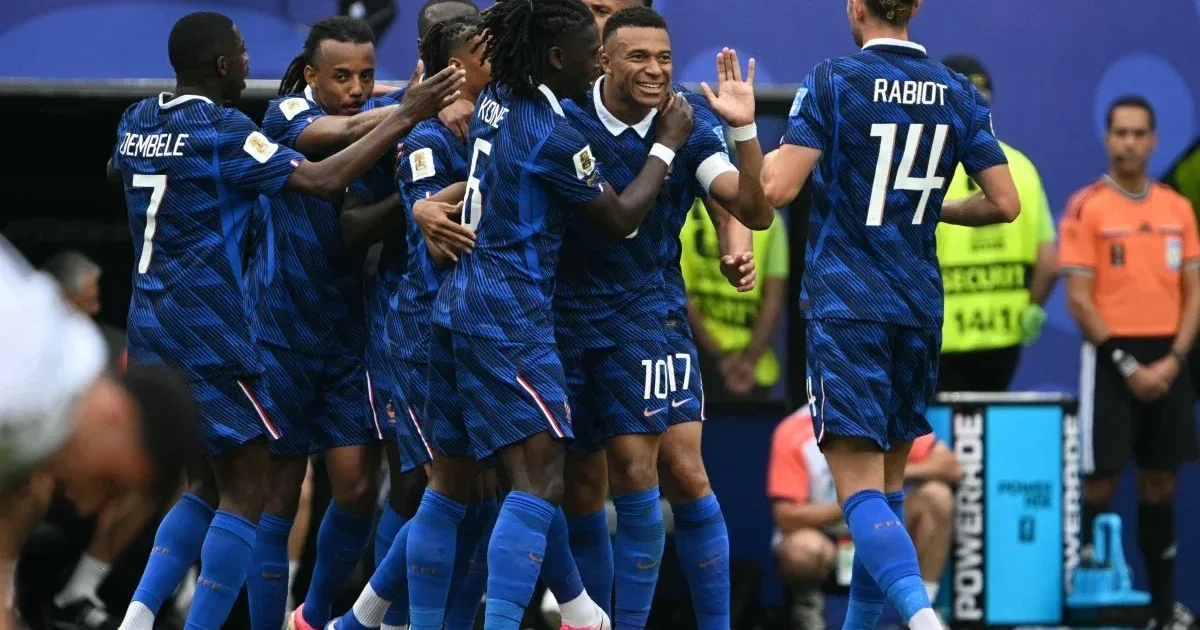
Kylian Mbappe’s 70th-minute penalty against Paraguay secured France’s quarter-final place at the 2026 World Cup, but the 1-0 scoreline flattered a performance that exposed alarming tactical and psychological cracks. Didier Deschamps’ side dominated possession yet managed only one clear chance before the VAR-awarded spot-kick, raising questions about their ability to break down organised low blocks without individual brilliance. Paraguay’s disciplined 4-4-1-1 formation, reinforced by 23 tackles and 15 interceptions, stifled France’s midfield creativity for 68 minutes, leaving Antoine Griezmann and Ousmane Dembele isolated against a wall of white shirts.
The heat in Philadelphia—98°F at kick-off—compounded France’s struggles, with hydration breaks disrupting their rhythm. Deschamps’ half-time substitution of Bradley Barcola for Désiré Doué injected urgency, yet the PSG forward’s penalty-winning foul owed more to luck than systemic pressure. Paraguay’s physicality, including three yellow cards for tactical fouls, rattled Les Bleus; Michael Olise and Manu Koné both picked up cautions for retaliatory challenges, while a frustrated Griezmann was booked for dissent. Deschamps admitted post-match that his players had been “dragged into an emotional battle,” a rare lapse in composure that could prove costly against Morocco’s counter-attacking threat.
France’s over-reliance on Mbappe is now a quantifiable weakness. The captain has scored 7 of their 14 World Cup goals in 2026, with no other player contributing more than one. His penalty against Paraguay was his 11th knockout-stage goal, breaking Ronaldo’s record, yet the team’s expected goals (xG) without his input drops to 0.8 per game—below the tournament average. Paraguay’s defensive structure, which allowed just 0.3 xG in open play, mirrored the blueprint Morocco used to dismantle Canada in their 3-0 Round of 16 win. Walid Regragui’s side conceded only 0.6 xG per game in the group stage, the lowest of any quarter-finalist, and will target France’s slow build-up play through Achraf Hakimi’s wing raids.
Deschamps’ squad depth is also under scrutiny. The absence of Eduardo Camavinga, rested after a minor ankle issue, left Aurélien Tchouaméni exposed in defensive transitions. Paraguay exploited this by funneling attacks down France’s left flank, where Theo Hernandez’s overlapping runs left space for Miguel Almirón’s counters. The 61st-minute introduction of Doué, a direct dribbler, temporarily shifted the dynamic, but France’s lack of a natural No. 9—Olivier Giroud remains sidelined with a calf strain—forced Mbappe to drop deep, diluting his threat. Deschamps’ reluctance to start 19-year-old Warren Zaïre-Emery, despite his Champions League breakthrough at PSG, suggests a conservative streak that may backfire against Morocco’s high press.
The psychological edge France held over Morocco after their 2022 semi-final win has evaporated. Regragui’s side have conceded just one goal in 360 minutes of knockout football, while France’s defensive frailties were laid bare by Paraguay’s late surges. The quarter-final in Foxborough will pit Mbappe against Hakimi in a personal duel, but France’s midfield collapse—Koné and Tchouaméni completed just 78% of their passes under pressure—could decide the tie. Deschamps’ post-match praise for his team’s “discipline” rings hollow; the data shows a side that survives on moments, not systems.
Boardroom interference adds another layer of instability. French Football Federation president Philippe Diallo has privately criticised Deschamps’ squad selection, particularly the omission of Real Madrid’s Ferland Mendy. The left-back’s defensive solidity and crossing ability could have mitigated Hernandez’s attacking deficiencies, but Deschamps’ loyalty to his 2018 core—Varane, Pavard, and Giroud—now looks outdated. With Varane’s contract expiring and Pavard linked to Bayern Munich, France’s backline lacks long-term cohesion. The quarter-final could be the last hurrah for this generation, with Mbappe’s free agency looming in 2025 and Real Madrid circling.
Paraguay’s tactical masterclass revealed a hidden flaw in France’s title credentials: their inability to adapt when Plan A fails. Against teams that sit deep, Deschamps’ side revert to hopeful crosses and Mbappe dribbles, a strategy Morocco will exploit. Regragui’s use of Sofiane Amrabat as a single pivot to shield the defence, combined with Hakimi and Noussair Mazraoui’s overlapping runs, mirrors the system that neutralised Spain’s possession dominance in the group stage. France’s xG chain—a metric measuring progressive passing sequences—dropped to 0.12 against Paraguay, their lowest in the tournament, indicating a midfield collapse under sustained pressure.
The quarter-final will hinge on two overlooked metrics. First, France’s pressing intensity: their PPDA (passes per defensive action) rose to 18.2 against Paraguay, the highest of any knockout-stage team, suggesting fatigue or tactical naivety. Second, Morocco’s set-piece threat: they’ve scored 40% of their World Cup goals from dead balls, with Romain Saïss and Nayef Aguerd dominating aerially. Deschamps’ decision to start Koné, a poor header of the ball, over Zaïre-Emery could prove decisive. With Mbappe’s penalty the only goal from open play in 180 minutes of knockout football, France’s title defence now rests on a knife-edge.