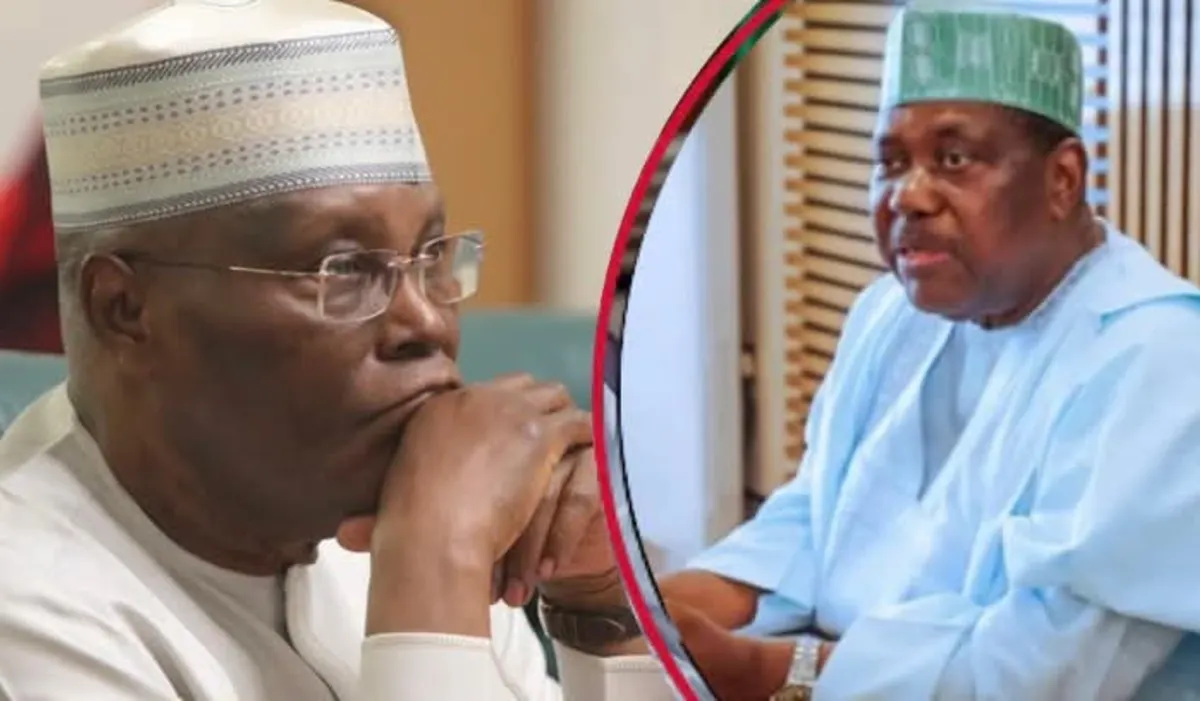
The Secretary to the Government of the Federation, George Akume, has dropped a political bombshell that reshapes the narrative around Nigeria’s rotational presidency agreement. Speaking at a World Press Conference in Abuja to mark the 27th Democracy Day anniversary, Akume revealed that former Vice President Atiku Abubakar was not just a bystander but a key architect of the power-sharing deal that emerged after the annulment of the June 12, 1993 presidential election. The disclosure, made with the weight of institutional authority, directly ties Atiku to the foundational decision that has dictated Nigeria’s political power dynamics for nearly three decades.
Akume’s account paints a vivid picture of the high-stakes negotiations that followed the military’s annulment of what remains Nigeria’s most credible election. Leaders of the Peoples Democratic Party (PDP) convened in Kaduna under the stewardship of the late Chief Solomon Lar and Alhaji Adamu Ciroma, with the spectre of national disintegration looming large. The meeting, described by Akume as a "tough argument," forced political elites to confront the raw consequences of the annulment. "We had to concede. We must do this," Akume recalled, framing the rotational presidency agreement as an emergency measure to prevent the country from fracturing along regional lines. Atiku’s presence at that table, now confirmed by the SGF, places him at the heart of a decision that has since become a sacred cow in Nigerian politics.
The mechanics of the rotational presidency deal reveal a calculated political trade-off. The agreement to alternate presidential power between the North and South was not born out of abstract principles of equity but as a direct response to the crisis triggered by the annulment of MKO Abiola’s victory. Akume’s narrative underscores how the military’s intervention in 1993 forced civilian leaders to adopt a power-sharing formula that would later become institutionalised in the PDP’s zoning arrangements. The SGF’s insistence that "Atiku was one of the leaders at that meeting" carries significant weight, given Atiku’s subsequent political career and his repeated bids for the presidency. It suggests that Atiku’s long-standing ambition has been pursued within a framework he helped create—a framework that now faces intense scrutiny as Nigeria approaches another election cycle.
The fallout from this revelation is already reverberating through Nigeria’s political landscape. Atiku, who has positioned himself as a champion of democratic principles, now faces questions about his consistency. If he was part of the decision to institutionalise rotational presidency, why has his political rhetoric in recent years often downplayed its significance? The SGF’s disclosure forces a reckoning with the hypocrisy that has long plagued Nigeria’s political class. Leaders who once defended rotational presidency as a necessary compromise for national unity now treat it as a bargaining chip, invoking it when convenient and discarding it when expedient. Akume’s account strips away the veneer of principle, exposing the raw pragmatism that underpins Nigeria’s power-sharing arrangements.
The timing of Akume’s revelation is particularly damaging for Atiku’s political ambitions. With the 2027 presidential election looming, the former vice president has been positioning himself as a unifying figure capable of bridging Nigeria’s regional divides. Yet, Akume’s disclosure complicates that narrative. If Atiku was indeed part of the original agreement to rotate power, his current campaign rhetoric—often critical of the very system he helped create—risks being perceived as opportunistic. The SGF’s statement also serves as a warning to other political actors: the rotational presidency deal was not a casual agreement but a hard-won compromise that came with expectations of adherence. Any deviation from it, Akume implies, risks reopening the wounds of June 12 and destabilising Nigeria’s fragile democratic consensus.
The institutional implications of Akume’s disclosure extend beyond Atiku’s political fortunes. The SGF’s confidence in Nigeria’s democratic institutions, particularly the Independent National Electoral Commission (INEC), carries an unmistakable subtext. By invoking the lessons of June 12, Akume is sending a clear message to INEC and other electoral bodies: the annulment of a credible election will not be tolerated again. His assertion that "the actors at INEC are not young people; they were adults when this thing happened" is a thinly veiled threat. It reminds electoral officials that they are being watched, that the ghosts of 1993 still haunt Nigeria’s democracy, and that any attempt to subvert the people’s will would invite a backlash of historic proportions. This warning comes at a critical juncture, as INEC prepares for the 2027 elections amid growing concerns about its independence and capacity to conduct free and fair polls.
The economic and operational pressures triggered by Akume’s disclosure are already being felt. Political analysts and strategists are recalibrating their projections for the 2027 election, factoring in the new revelations about Atiku’s role in the rotational presidency deal. The disclosure has forced a reassessment of the PDP’s internal dynamics, particularly the party’s adherence to its zoning principles. If Atiku, a northerner, was part of the original agreement to rotate power to the South, his pursuit of the presidency in 2027 could be seen as a betrayal of that deal. This perception could alienate southern PDP leaders and fracture the party’s support base, creating an opening for other political forces to exploit. The operational fallout is equally significant. Campaign teams are now scrambling to adjust their messaging, anticipating attacks on Atiku’s consistency and commitment to the rotational presidency principle.
The systemic mechanics governing Nigeria’s rotational presidency agreement reveal a fragile balance of power. The deal was never codified in the constitution but emerged as an informal consensus among political elites. This lack of legal backing has allowed successive administrations to interpret the agreement flexibly, often bending it to suit their political needs. Akume’s disclosure underscores the inherent instability of this arrangement. Without a constitutional anchor, the rotational presidency deal remains vulnerable to manipulation, with each election cycle bringing fresh debates about its relevance and enforceability. The SGF’s account also highlights the role of regional power brokers in upholding the agreement. The Kaduna meeting that birthed the deal was not a democratic exercise but a closed-door negotiation among political elites. This elitist origins of the rotational presidency deal raise questions about its legitimacy and sustainability. If the agreement was imposed by a small group of leaders, can it truly reflect the will of the Nigerian people?
The immediate consequences of Akume’s revelation are already playing out in Nigeria’s political arena. Atiku’s camp has yet to issue a formal response, but the silence is deafening. The former vice president’s political opponents are seizing on the disclosure, framing it as evidence of his opportunism. The All Progressives Congress (APC), in particular, is likely to weaponise Akume’s statement in the coming weeks, using it to undermine Atiku’s credibility and portray him as a flip-flopper. The operational pressure on Atiku’s campaign team is immense. They must now craft a response that reconciles his past support for rotational presidency with his current presidential ambitions. Failure to do so could alienate key constituencies, particularly in the South, where the expectation of a power shift remains strong. The clock is ticking. With the 2027 election less than a year away, Atiku’s team has little time to contain the fallout from Akume’s disclosure. The stakes could not be higher. If Atiku fails to navigate this crisis effectively, his presidential bid could collapse under the weight of his own contradictions.