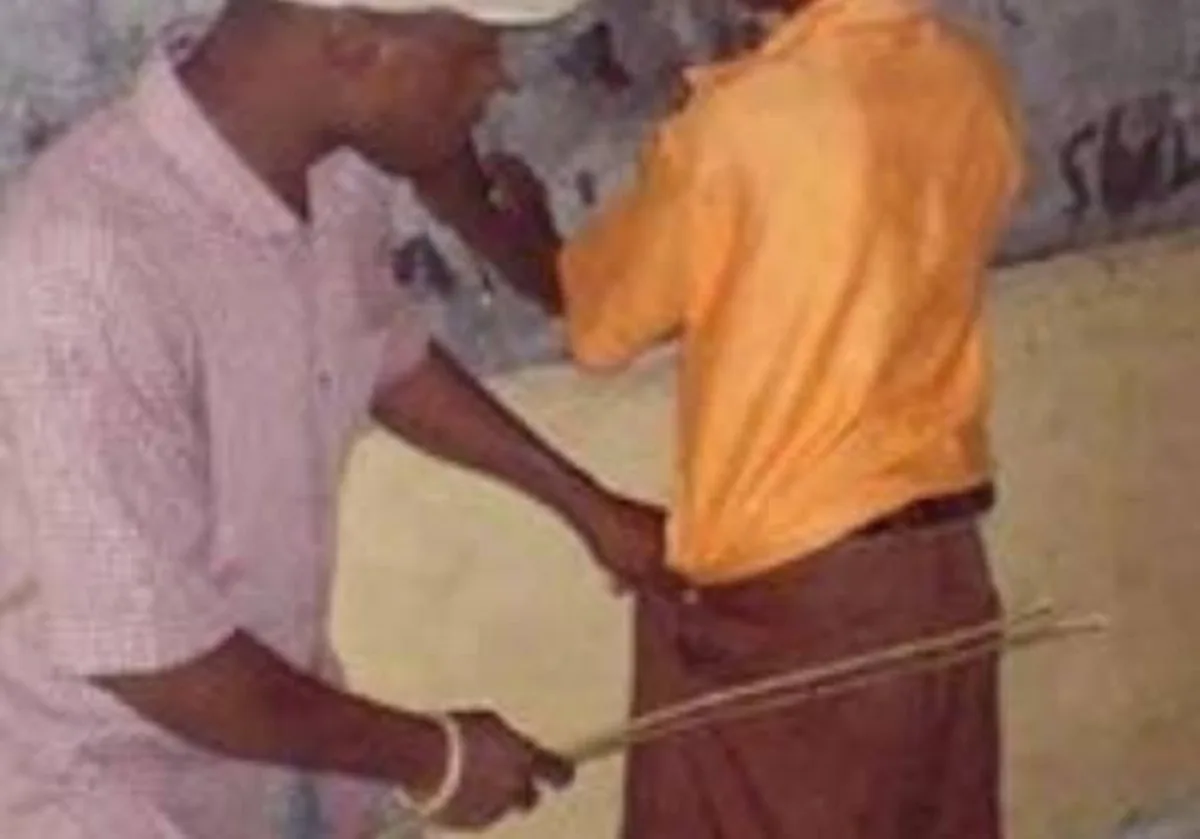

The Oyo State Police Command has arrested a masquerade known as Asoleke for the murder of 24-year-old Sefiu Kehinde during a traditional procession in Ibadan. Four accomplices remain at large. The killing occurred on Sunday in the Labiran area when the victim was attacked with axes and cutlasses by the masquerade and its followers.
The police report states that Mrs Aderemi, the deceased’s sister, filed the initial complaint at the Mapo Divisional Police Headquarters. She received a distress call from her elder sister around 4:00 p.m. reporting that Asoleke and his followers had assaulted Kehinde. Officers from Mapo Division responded immediately and rushed the victim to a hospital. He was pronounced dead on arrival. The crime scene was documented and the body released to the family for Islamic burial rites.
The Commissioner of Police, Abimbola Olugbemiga, has transferred the case to the State Criminal Investigation Department for deeper scrutiny. He assured the public that efforts to apprehend the remaining suspects are underway. Residents have been urged to provide any credible information that could aid the investigation. The command reiterated its commitment to bringing all perpetrators to justice and maintaining public safety across the state.
This incident exposes a recurring pattern of violence during traditional masquerade festivals in Nigeria. While these events are culturally significant, they often escalate into clashes with fatal consequences. In Oyo State alone, at least three similar cases have been recorded in the past two years. Security experts attribute this trend to inadequate crowd control measures and the absence of clear regulatory frameworks governing such processions. The police typically deploy minimal personnel to these events, leaving communities vulnerable to sudden outbreaks of violence.
The financial burden of such killings on affected families is often overlooked. Kehinde’s family now faces the dual challenge of grief and economic strain. Funeral expenses in Nigeria average between ₦500,000 and ₦2 million depending on religious and cultural requirements. Many low-income families resort to borrowing or selling assets to cover these costs. The Oyo State government offers no formal compensation scheme for victims of violent crime, leaving families to navigate their losses without institutional support.
Local governance failures compound the problem. The Labiran community falls under the Ibadan North-East Local Government Area. Councillors and the local government chairman have remained silent on the incident. No public statement has been issued regarding preventive measures for future festivals. This silence reflects a broader pattern where local officials avoid accountability for security lapses. The 2024 Supreme Court ruling granting financial autonomy to local governments was intended to address such gaps. Yet implementation remains inconsistent, with state governors still exerting undue influence over council operations.
The role of traditional rulers in curbing masquerade violence has also come under scrutiny. The Olubadan of Ibadan, Oba Owolabi Olakulehin, has not publicly addressed the killing. Traditional rulers wield significant influence over cultural festivals but rarely intervene in cases of violence. Their reluctance stems from fears of alienating community leaders who organize these events. Without their active involvement, preventive measures remain ineffective. Security analysts recommend mandatory pre-festival security briefings involving traditional rulers, police, and community leaders to mitigate risks.
The psychological impact on witnesses and the broader community is profound. Residents of Labiran report heightened anxiety during festival periods. Children are often kept indoors, and businesses close early. The trauma of witnessing such violence can have long-term effects on mental health. Nigeria’s mental health infrastructure is ill-equipped to handle such fallout. The country has fewer than 300 psychiatrists serving a population of over 200 million. Community-based trauma counseling programs are virtually nonexistent, leaving victims and witnesses without recourse.
The Oyo State Police Command’s response highlights systemic challenges in Nigeria’s law enforcement. While the arrest of Asoleke is a positive step, the manhunt for the four accomplices underscores the difficulties in tracking suspects in densely populated urban areas. Police stations in Ibadan operate with limited forensic capabilities. Most investigations rely on witness testimonies and basic crime scene documentation. The transfer of the case to the SCID suggests an acknowledgment of these limitations. However, the SCID itself faces resource constraints, including a backlog of over 5,000 unresolved cases statewide.