
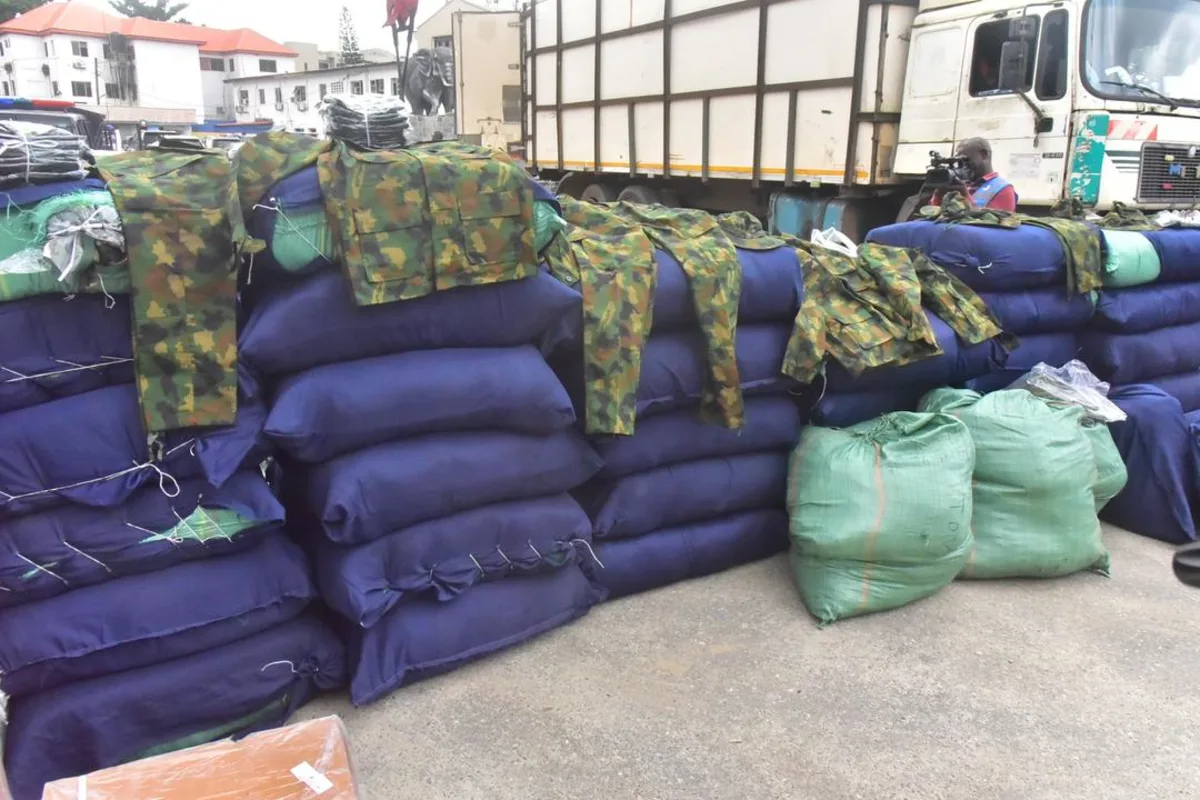
The Lagos State Police Command has uncovered a large-scale smuggling operation involving military camouflage, firearms, and illicit drugs. Commissioner of Police Fatai Tijani revealed the interception of a truck carrying 8,000 pieces of military camouflage packed in 47 sacks. The haul also included 80 cartons of suspected narcotics. Three suspects—Chinedu David (29), Ezeagwu Chukwuma (38), and Ifeanyi Ogbeanyi (45)—were arrested during the operation.
The seized truck, an unregistered MAN diesel vehicle, was reportedly en route to eastern Nigeria. Police sources confirmed the camouflage uniforms were destined for unidentified recipients in the region. Investigations are now focused on tracing the origin of the contraband and mapping the distribution network. Tijani emphasized that the command is determined to dismantle the syndicate behind the smuggling ring. He warned that all individuals connected to the operation would face prosecution under Nigerian law.
The discovery raises serious questions about the security of Nigeria’s military supply chains. Military camouflage is classified as restricted material under the Firearms Act and the Armed Forces Act. Unauthorized possession or distribution carries a minimum prison sentence of ten years. The scale of the seizure—8,000 uniforms—suggests a well-funded operation with potential links to armed groups or criminal syndicates operating in the South-East. Security analysts note that such quantities could equip a small militia or be sold on the black market to insurgents and bandits.
The operation also exposed a parallel drug trafficking network. The 80 cartons of suspected narcotics recovered alongside the military gear indicate a convergence of arms smuggling and drug distribution. Police forensic teams are analyzing the substances to determine their composition and origin. The National Drug Law Enforcement Agency (NDLEA) has been notified and is collaborating with the Lagos Command to trace the drug supply chain. This dual seizure underscores the growing trend of criminal organizations diversifying their operations to maximize profits and evade detection.
The Lagos Police Command’s Anti-Kidnapping Unit led the raid following intelligence reports. The unit has been under pressure to curb rising kidnapping incidents in the state, many of which involve armed gangs using military-grade equipment. The seizure of firearms and ammunition during the same operation suggests a direct link between the smuggling ring and violent crime. Tijani confirmed that some of the recovered weapons were traced to recent armed robberies and kidnappings in Lagos and Ogun states.
A less scrutinized aspect of this case is the role of corrupt insiders within security agencies. The sheer volume of military camouflage—enough to fill 47 sacks—points to possible collusion with personnel at military depots or logistics units. Investigators are examining whether the uniforms were stolen from official stockpiles or illegally procured through forged documents. The Nigerian Army has launched an internal audit of its inventory to identify potential leaks. This incident mirrors a 2022 case in Port Harcourt, where police intercepted a similar shipment of military gear linked to a retired army officer.
The economic implications of this smuggling operation extend beyond security concerns. The black-market value of 8,000 military uniforms is estimated at over ₦200 million. The influx of such large quantities of contraband into the South-East could destabilize local economies by flooding markets with cheap, illegal goods. Additionally, the use of military camouflage by criminal gangs erodes public trust in security forces. Civilians may struggle to distinguish between legitimate soldiers and armed impostors, increasing the risk of misidentification and violent confrontations.
The Lagos Command’s broader crackdown has yielded additional results. In separate operations, police arrested a suspect linked to a ‘one-chance’ robbery syndicate and recovered 51 stolen mobile phones. Two cable vandals were caught on the Third Mainland Bridge, and 14 firearms were seized from suspected cultists affiliated with the Eiye and Alora confraternities. The command also rescued 38 foreign nationals in Epe, including 20 who entered Nigeria illegally. These arrests highlight the multifaceted nature of organized crime in Lagos and the need for coordinated law enforcement responses.
This case serves as a litmus test for Nigeria’s ability to secure its borders and enforce arms control laws. The Federal Government has repeatedly pledged to tackle smuggling and illicit arms proliferation, but implementation remains weak. The Lagos seizure demonstrates that criminal networks continue to exploit gaps in border security and inter-agency coordination. Without stricter oversight of military logistics and harsher penalties for smugglers, such operations will persist, fueling violence and undermining national security.